Verified by Recoward Print — Nigeria’s Premier Commercial Printing & Branding Partner.
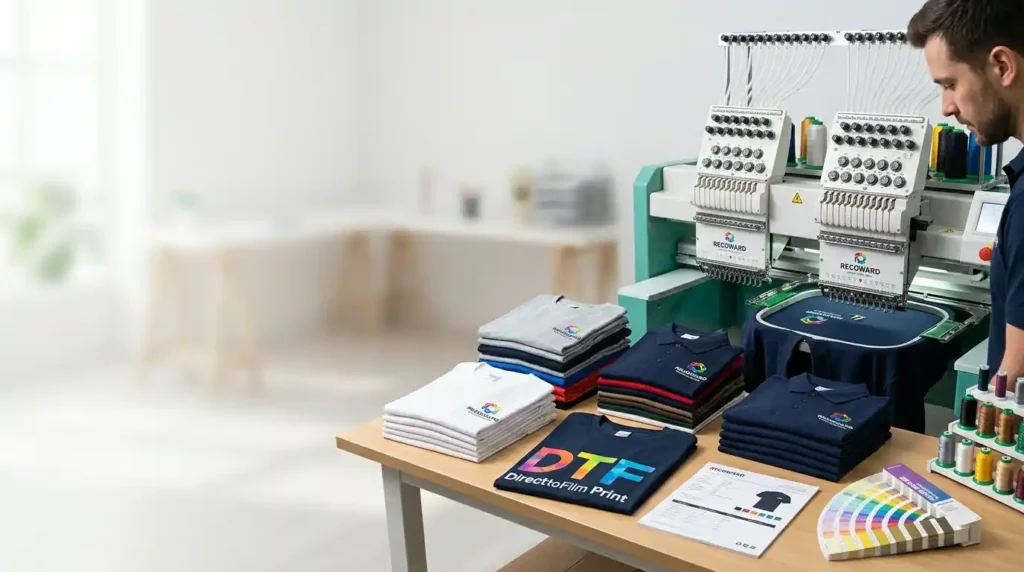
Bulk Corporate T-Shirt Printing in Lagos & Ogun State: Complete Procurement Guide
Bulk Branded T-Shirts & Corporate Polo Printing in Lagos & Ogun State Nigeria
Businesses ordering branded clothing in large quantities need more than a printer who can put a logo on a shirt.
For corporate uniforms, staff T-shirts, branded polo shirts, promotional campaigns, conferences, activations, schools, NGOs, churches, hospitality teams and company events, the quality of the final apparel depends on several decisions made before production begins: fabric composition, garment weight, sizing, colour consistency, branding technique, artwork preparation, finishing, quality control and delivery planning.
This is particularly important when sourcing bulk corporate T-shirt printing in Lagos and Ogun State, where buyers may be comparing different suppliers, garment qualities and production methods while working against a fixed budget and deadline.
A low quotation can become expensive if the shirts shrink, the logo cracks, the colours do not match the company’s brand identity, different batches look different, or the supplier cannot deliver the complete order on time.
The better approach is to treat branded apparel as a procurement project, not simply a printing job.
This guide explains how to choose the right T-shirts and polo shirts, compare printing and embroidery methods, specify quantities and sizes, control quality, estimate production timelines, and avoid common mistakes when ordering corporate apparel in Lagos, Ogun and across Nigeria.
What Is Bulk Corporate T-Shirt Printing?
Bulk corporate T-shirt printing is the production and branding of multiple garments with a company’s logo, brand identity, employee information, campaign message, event artwork or other approved design.
Depending on the organisation’s requirements, the order may include:
- Branded corporate T-shirts
- Corporate polo shirts
- Staff uniforms
- Event T-shirts
- Promotional T-shirts
- Team shirts
- Conference shirts
- School and institutional apparel
- NGO and charity campaign shirts
- Church and ministry shirts
- Hospitality uniforms
- Retail staff clothing
- Field-worker uniforms
- Branded promotional merchandise
The word bulk does not necessarily mean every order has the same minimum quantity. Suppliers may set their own minimum order quantities, while pricing commonly changes according to quantity, garment specification, number of print locations and branding method.
For example, some Lagos suppliers currently advertise minimum orders ranging from around 10 to 30 pieces, while others structure their corporate production around larger quantities.
Therefore, companies should not choose a supplier simply because the website says “bulk printing.” The important question is whether the supplier can consistently deliver the required garment specification, branding quality, quantity and deadline.
Why Businesses Need to Be Careful When Ordering Branded T-Shirts in Bulk
Ordering 10 shirts is very different from ordering 100, 500 or 2,000.
When only a few shirts are required, a mistake may be inconvenient.
When hundreds of garments are involved, the same mistake becomes a significant procurement problem.
A company can receive an order where:
- Some shirts are noticeably different in colour.
- Sizes do not correspond consistently.
- The fabric is thinner than expected.
- The logo is positioned differently from shirt to shirt.
- Embroidery is too dense or poorly finished.
- Printed graphics crack or peel prematurely.
- The print colour does not reproduce the brand identity accurately.
- Some garments shrink after washing.
- The supplier delivers only part of the order by the event date.
- Replacement garments are unavailable because the original fabric is out of stock.
The Standards Organisation of Nigeria (SON) maintains standards covering areas including woven fabrics, knitted fabrics, ready-made garments, dyes and related textile products. SON also states that Nigerian Industrial Standards are intended to establish requirements that help products remain fit for purpose and comparable.
For larger corporate procurement projects, this reinforces an important principle:
Do not procure branded apparel on price alone. Procure against a written specification.
How to Choose the Right Fabric for Corporate T-Shirts
Fabric selection should come before printing.
The printing method must be compatible with the garment, and the garment itself must be appropriate for how employees or customers will use it.
There is no single fabric that is best for every corporate order.
1. 100% Cotton T-Shirts
Cotton remains a popular option for corporate T-shirts because it is comfortable, breathable and generally well suited to many decoration processes.
For businesses looking for everyday staff T-shirts, promotional wear or event apparel, cotton can provide a comfortable and relatively versatile base.
Cotton is also particularly suitable for direct-to-garment printing because its natural fibres provide a good surface for ink and pretreatment. Brother’s garment-printing documentation notes that open, porous fibres such as 100% cotton are particularly suitable for garment printing.
However, cotton quality varies significantly.
Two shirts can both be labelled “100% cotton” while feeling completely different because of differences in:
- Yarn quality
- Knitting
- Fabric construction
- Finishing
- Weight
- Shrinkage
- Dye quality
- Garment construction
For a corporate procurement project, therefore, “100% cotton” is a starting specification, not a complete quality specification.
Understanding GSM When Buying Corporate T-Shirts
GSM means grams per square metre and is commonly used to describe fabric weight.
Generally, a higher GSM indicates a heavier fabric, although GSM alone does not determine whether a garment is comfortable or high quality.
For corporate buyers, the important point is to select a weight appropriate for the intended use.
Lightweight T-Shirts
Useful for:
- Outdoor events
- Promotional campaigns
- Hot-weather activities
- Large-scale giveaways
- Short-duration event uniforms
Medium-weight T-Shirts
Useful for:
- General staff uniforms
- Corporate events
- Promotional campaigns
- Everyday branded clothing
Heavier-weight T-Shirts
Useful for:
- Premium merchandise
- Fashion-oriented corporate apparel
- Long-term uniforms
- Higher-end promotional products
A heavier shirt is not automatically better.
In Lagos and Ogun’s warm climate, a very heavy garment may become uncomfortable for employees who wear it for extended periods, especially for outdoor work.
The correct question is:
What combination of fabric weight, fibre composition, construction and garment design is appropriate for the employee’s actual working environment?
Corporate Polo Shirts: When Should You Choose Them?
Polo shirts are often a better choice than round-neck T-shirts when a company wants a more formal corporate appearance.
They are commonly used for:
- Office staff
- Sales representatives
- Retail teams
- Hotel employees
- Customer-facing employees
- Banks and financial-service teams
- Logistics teams
- Field staff
- Conference teams
- Corporate events
A polo can provide a balance between comfort and a more structured appearance.
For example, current Nigerian apparel suppliers advertise cotton pique and cotton-blend polo options for corporate uniforms and branded workwear.
For polo procurement, inspect:
- Collar construction
- Button quality
- Fabric weight
- Fabric composition
- Seam finishing
- Sleeve construction
- Side vents
- Shrinkage
- Colour consistency
- Size consistency
- Logo placement
For a professional corporate appearance, embroidery is frequently considered for smaller chest logos, while screen printing or other transfer methods may be more appropriate for larger or more graphic designs.
Cotton vs Cotton-Polyester Blend for Corporate Uniforms
A cotton-polyester blend can make sense when durability, shape retention and repeated use are important.
However, buyers should not assume that every cotton-polyester blend will behave identically during printing.
The fibre composition can affect how inks, pretreatment and heat interact with the garment. Brother’s technical documentation notes that polyester fibres are less porous than cotton and that blends can require different printing and curing approaches.
This matters particularly for digital printing.
If a supplier recommends a 50/50 or other blend, ask:
- What percentage is cotton?
- What percentage is polyester?
- Which printing method will be used?
- Has the exact garment been tested?
- Has the print been wash-tested?
- Will the same garment be available for repeat orders?
This last question is often overlooked.
If a company expects to reorder uniforms every quarter or every year, garment availability and specification consistency become procurement considerations.
The Best Printing Method for Bulk Corporate T-Shirts
There is no universally “best” printing method.
The appropriate method depends on:
- Quantity
- Artwork complexity
- Number of colours
- Fabric type
- Garment colour
- Print size
- Number of print locations
- Required durability
- Budget
- Production deadline
The major methods include:
- Screen printing
- Direct-to-film (DTF)
- Direct-to-garment (DTG)
- Embroidery
- Dye sublimation
- Heat-transfer methods
1. Screen Printing for Bulk Corporate T-Shirts
Screen printing remains one of the most useful methods for larger-volume apparel orders, especially when the design is relatively simple and repeated across many garments.
It can be particularly suitable for:
- Company logos
- One- to several-colour designs
- Large front prints
- Large back prints
- Event T-shirts
- Campaign shirts
- High-volume promotional orders
One major advantage is economics at scale.
Screen printing requires setup, so it may not be the most efficient solution for a very small order. As quantity increases, however, the setup cost can be distributed across more garments.
Industry printing guidance similarly identifies screen printing as a cost-effective approach for high-quantity jobs, particularly where designs do not require unlimited colours or gradients.
Screen printing is particularly attractive when:
- You are ordering hundreds of identical shirts.
- The artwork uses a limited number of colours.
- You need a large print.
- You want a repeatable production process.
- Cost per shirt is an important consideration.
2. DTF Printing for Corporate T-Shirts
DTF means Direct-to-Film.
The design is printed onto a special film, adhesive powder is applied and cured, and the design is transferred onto the garment using heat.
DTF is useful when artwork contains:
- Multiple colours
- Gradients
- Fine details
- Photographic elements
- Complex logos
- Small text
- Intricate illustrations
One advantage of DTF is that the design does not require the traditional screen setup associated with screen printing.
Industry guidance describes DTF as particularly useful for intricate designs and smaller quantities, while also noting that very large prints can feel heavier and that high-volume screen printing may be more economical in appropriate cases.
Modern DTF systems can also be used across a broad range of fabrics. Epson’s current documentation describes DTFilm as suitable for a wide range of fabric types, while noting that the exact transfer conditions depend on the material and transfer system.
DTF can be a strong choice when:
- The logo contains many colours.
- The design includes gradients.
- You need detailed artwork.
- The order quantity is moderate.
- Several different designs are required.
- You want flexibility across different garment colours and materials.
However, do not automatically assume DTF is the cheapest option for a very large order.
For 500 or 1,000 shirts carrying a simple two-colour corporate logo, a properly quoted screen-printing job may be more economical.
3. Embroidery for Corporate Polo Shirts
Embroidery uses thread rather than ink or film to reproduce the logo.
It is particularly appropriate for:
- Corporate polos
- Executive shirts
- Jackets
- Caps
- Hospitality uniforms
- Formal staff uniforms
- Workwear
Embroidery can give a logo a raised, premium appearance and can be particularly effective for simple corporate marks.
However, embroidery has its own technical considerations.
The cost and visual result can be influenced by:
- Stitch count
- Logo size
- Number of thread colours
- Garment thickness
- Logo complexity
- Placement
A detailed logo may need to be simplified before embroidery.
For example, tiny text that looks readable on a computer screen may become illegible when converted into stitches.
A useful rule:
If the logo is small and formal, consider embroidery. If the artwork is large, highly detailed or gradient-heavy, consider printing.
In some corporate uniforms, both methods can be combined—for example, an embroidered chest logo with a larger printed design on the back.
4. Sublimation Printing
Dye sublimation is particularly associated with polyester garments.
It is widely used for:
- Sports jerseys
- Athletic wear
- Performance apparel
- Full-colour team uniforms
- All-over designs
However, sublimation has an important limitation for corporate T-shirts:
Traditional dye sublimation is generally most suitable for white or light-coloured polyester fabrics.
Epson specifically advises using white or light-coloured polyester for best sublimation results and notes that conventional dye sublimation is not suitable for cotton or dark garments.
Therefore, if a company wants a black 100% cotton corporate T-shirt with a small chest logo, sublimation would usually not be the first method to investigate.
Corporate T-Shirt Printing Method Comparison
| Branding Method | Best For | Main Advantage | Main Limitation |
|---|---|---|---|
| Screen Printing | Large-volume simple designs | Economical at scale | Less flexible for complex full-colour artwork |
| DTF | Detailed, full-colour designs | Excellent design flexibility | Large prints can have more surface feel |
| Embroidery | Corporate polos and formal uniforms | Premium, professional appearance | Not ideal for very detailed artwork |
| Sublimation | Sports/performance polyester | Excellent full-colour coverage | Primarily suited to light polyester |
| DTG | Detailed cotton garments and smaller runs | Soft, detailed print | Requires appropriate garment/pretreatment |
| Heat Transfer | Names, numbers and smaller jobs | Flexible and convenient | Method-specific durability varies |
The final decision should be based on the garment + artwork + quantity + intended use, rather than choosing a printing method in isolation.
How Many T-Shirts Should a Company Order?
The correct quantity depends on how the garments will be used.
For staff uniforms, calculate more than the number of employees.
For example, if a company has 50 employees, it may not make sense to order exactly 50 shirts if the shirts are expected to be worn regularly.
Consider:
- Number of employees
- Number of shirts per employee
- Spare garments
- New employees
- Replacement requirements
- Different departments
- Different sizes
- Event requirements
- Expected duration of use
A company with 50 employees might need two or three shirts per employee, depending on its uniform policy.
For an event, the calculation may be different because the shirts may be used for a single activation or conference.
How to Build a Corporate T-Shirt Size Breakdown
Never tell a supplier only:
“We need 200 shirts.”
Provide a size breakdown.
For example:
| Size | Quantity |
|---|---|
| S | 20 |
| M | 55 |
| L | 65 |
| XL | 40 |
| XXL | 15 |
| 3XL | 5 |
| Total | 200 |
The actual distribution should come from the organisation’s employee or attendee data.
For larger orders, avoid guessing sizes.
If possible, have employees try on a sample garment before the full production run.
This can prevent a costly situation where the supplier delivers hundreds of technically correct shirts that do not fit the intended users.
Why Physical Samples Matter
A digital mockup is not the same as a physical sample.
A screen can show the logo in the correct position, but it cannot tell you:
- How the fabric feels
- Whether the collar sits correctly
- Whether the shirt is too thin
- How the embroidery looks at actual size
- Whether the print is too large
- Whether the colour works against the garment
- Whether the garment shrinks
- Whether the sizing is consistent
For larger corporate orders, request a physical pre-production sample whenever practical.
A professional workflow should generally look like:
Brief → Specification → Artwork → Digital proof → Physical sample → Approval → Production → Quality control → Delivery
Some Lagos apparel suppliers explicitly use workflows involving role mapping, specification, sample approval and production rollout.
How to Prepare Your Logo for T-Shirt Printing
Artwork quality directly affects the final result.
Whenever possible, provide the original brand artwork rather than sending a screenshot downloaded from WhatsApp.
Preferred formats may include:
- AI
- EPS
- SVG
- High-resolution PNG where appropriate
A vector logo is particularly useful because it can be scaled without losing the clean geometric edges needed for professional branding.
Your brand team should also provide:
- Logo files
- Brand colours
- Colour codes where available
- Approved logo variations
- Clear-space requirements
- Minimum logo size
- Preferred print position
- Approved fonts where applicable
If the company has formal brand guidelines, give them to the apparel supplier before production.
Brand Colour Matching Is More Important Than Many Buyers Realise
A company’s brand colour may look different depending on:
- Fabric colour
- Fabric composition
- Printing method
- Ink
- Thread
- Screen settings
- Lighting
- Finishing
- Production batch
For corporate procurement, don’t simply say:
“Use our blue.”
Give the supplier the official brand specification if one exists.
Where available, provide the appropriate colour reference from the company’s brand guidelines.
Most importantly, approve a physical sample before authorising the entire production run when colour accuracy matters.
How to Specify Logo Placement
A corporate apparel specification should clearly define where the branding goes.
Common locations include:
Left Chest
Best suited to:
- Corporate logos
- Employee uniforms
- Polos
- Formal staff apparel
Right Chest
Often used for:
- Department names
- Employee names
- Partner logos
Back
Useful for:
- Large company branding
- Campaign messages
- Event names
- Website addresses
- Social media handles
Sleeve
Useful for:
- Department branding
- Campaign logos
- Small secondary marks
If several print positions are required, make this explicit in the quotation request because the number of branding locations affects production cost.
What Should Be Included in a Corporate T-Shirt Printing Quote?
A professional quotation should be detailed enough for procurement teams to compare suppliers fairly.
Ask for the following:
- Garment type
- Fabric composition
- Fabric weight/GSM where relevant
- Garment colour
- Size range
- Total quantity
- Size breakdown
- Branding method
- Number of print locations
- Print dimensions
- Number of colours where relevant
- Embroidery stitch-count assumptions where applicable
- Sample cost
- Production cost
- Packaging
- Delivery
- VAT or other applicable charges
- Production timeline
- Payment terms
- Replacement/defect policy
This prevents the common procurement problem of comparing a premium specification with a low-quality specification simply because both are described as “branded T-shirts.”
What Affects the Price of Bulk Corporate T-Shirt Printing in Lagos?
There is no single universal price for bulk branded T-shirts.
The final quotation can depend on:
1. Quantity
Larger orders may reduce the unit cost because setup and production costs are distributed across more garments.
2. Garment Quality
Basic promotional shirts and premium corporate shirts have different costs.
3. Fabric
Cotton, polyester, blends, pique and performance fabrics can have different costs.
4. Branding Method
Embroidery, screen printing, DTF, DTG and sublimation involve different production processes.
5. Number of Print Locations
A left-chest logo is not the same production requirement as front + back + sleeve branding.
6. Artwork Complexity
A simple one-colour logo may cost differently from a large photographic design.
7. Number of Sizes
Some suppliers may price certain sizes differently, particularly larger or specialised sizes.
8. Delivery
Delivery to Lagos Mainland, Lagos Island, Ikeja, Lekki, Ota, Sango-Ota or other locations may have different logistics costs.
9. Deadline
Urgent production may require additional resources or rush scheduling.
Current Nigerian suppliers publicly advertise substantially different starting prices and turnaround periods, demonstrating why buyers should request a quotation based on their actual specification rather than relying on a generic “price per T-shirt.”
Bulk Corporate T-Shirt Printing in Lagos and Ogun State
Businesses sourcing branded apparel in Lagos and Ogun may be operating across several commercial and industrial areas.
Depending on the supplier, services may cover areas such as:
- Ikeja
- Yaba
- Surulere
- Somolu
- Lekki
- Victoria Island
- Lagos Island
- Mainland Lagos
- Oshodi
- Isolo
- Alimosho
- Agege
- Ikorodu
- Iganmu
- Ota
- Sango-Ota
- Agbara
- Abeokuta
- Other locations across Ogun State
The important point is not simply whether a supplier says it “delivers nationwide.”
Ask:
Where is production carried out, where is quality control performed, and how will delivery be handled for this specific order?
For an urgent corporate project, local production capacity and logistics can make a meaningful difference.
T-Shirt Printing in Ota and Ogun State: What Businesses Should Consider
Ota and the surrounding Ogun industrial corridor have a substantial concentration of businesses, factories, warehouses, logistics companies and commercial operations.
For companies operating in Ota, Sango-Ota, Agbara and nearby areas, branded apparel may be required for:
- Factory staff
- Warehouse teams
- Security teams
- Sales representatives
- Field workers
- Corporate events
- Staff identification
- Promotional campaigns
- Company anniversaries
- Recruitment events
For industrial or field environments, fabric selection becomes particularly important.
A shirt intended for office staff may not be appropriate for employees working outdoors or in a physically demanding environment.
The buyer should therefore specify the working conditions before selecting the garment.
Corporate T-Shirts vs Promotional T-Shirts
These terms are sometimes used interchangeably, but the procurement objective can be different.
Corporate Uniform
The primary objective is usually:
- Professional appearance
- Employee identification
- Brand consistency
- Repeated use
- Comfort
- Durability
The company may prioritise a better-quality garment and embroidery or refined printing.
Promotional T-Shirt
The primary objective may be:
- Brand visibility
- Campaign reach
- Event participation
- Marketing exposure
- Cost per unit
The buyer may prioritise price and visual impact.
Neither approach is automatically better.
The correct specification depends on the purpose of the garment.
Corporate Event T-Shirts
For conferences, product launches, exhibitions and activations, speed can be as important as quality.
A good event apparel plan should begin before the event date.
Do not calculate production time from the day you need the shirts.
Work backwards:
Event date → delivery date → quality inspection → production → sample approval → artwork approval → quotation → supplier selection
This provides room to handle unexpected problems.
A supplier may advertise a three-to-five-business-day production window, for example, but the buyer should confirm whether that timeline starts after payment and artwork approval, and whether delivery is included. Nigerian printing suppliers publicly publish different turnaround windows, reinforcing the importance of confirming the actual production schedule for the specific order.
How Long Does Bulk T-Shirt Printing Take?
There is no single standard turnaround time.
Production can depend on:
- Quantity
- Fabric availability
- Garment availability
- Artwork complexity
- Branding method
- Number of print locations
- Embroidery complexity
- Sampling requirements
- Supplier workload
- Delivery location
Some Nigerian suppliers advertise production windows of approximately 1–2 business days for certain products, while others quote 3–5 or 3–7 working days depending on the service.
These should be treated as supplier-specific estimates, not a universal industry standard.
For a major corporate order, build contingency time into the project.
If the event is Friday, do not plan for the shirts to arrive Friday morning.
Bulk T-Shirt Quality Control Checklist
Before accepting a large order, inspect the garments against the approved specification.
Garment Inspection
Check:
- Fabric quality
- Colour
- Size
- Stitching
- Collar
- Sleeves
- Seams
- Labels
- General finishing
Printing Inspection
Check:
- Logo position
- Print size
- Colour
- Sharpness
- Alignment
- Coverage
- Adhesion
- Consistency between garments
Embroidery Inspection
Check:
- Stitch density
- Logo shape
- Thread colour
- Alignment
- Loose threads
- Backing
- Consistency
Quantity Inspection
Count:
- Total garments
- Each size
- Each colour
- Each design
- Each department if applicable
Do not wait until employees discover problems.
Common Mistakes When Ordering Bulk Branded T-Shirts
Mistake 1: Choosing the Cheapest Quote
A low price may reflect a cheaper garment, less branding, fewer print locations or a different production specification.
Compare like-for-like specifications.
Mistake 2: Approving Only a Digital Mockup
A digital mockup cannot reproduce the physical feel and appearance of a real garment.
For significant orders, request a sample.
Mistake 3: Ignoring Fabric Composition
A design may look excellent on one garment and behave differently on another.
The fabric must be considered alongside the printing process.
Mistake 4: Guessing Employee Sizes
Collect actual sizes or provide fitting samples.
Mistake 5: Sending a Low-Resolution Logo
A blurry logo produces poor production artwork.
Provide the original brand files.
Mistake 6: Ordering Too Close to the Event
A production problem becomes an emergency when there is no contingency time.
Mistake 7: Forgetting Repeat Orders
If uniforms will be reordered, document:
- Garment supplier
- Garment model
- Fabric specification
- Colour
- Branding method
- Logo dimensions
- Logo placement
- Thread/ink specifications
- Size chart
This creates a repeatable procurement specification.
How to Maintain Branded T-Shirts After Delivery
Even a high-quality print can be damaged by poor garment care.
For many printed garments, following the manufacturer’s care instructions and washing printed shirts inside out can help maintain print quality. Epson specifically recommends washing printed garments inside out in cold water and following the garment manufacturer’s care guidance.
For corporate uniforms:
- Follow the garment care label.
- Avoid unnecessarily aggressive washing.
- Use appropriate detergent.
- Avoid excessive heat where the garment instructions prohibit it.
- Do not assume all printed garments can be treated identically.
- For embroidered apparel, follow the care requirements for both the garment and thread.
Proper maintenance should be communicated to employees when the apparel is intended for long-term use.
A Better Procurement Process for Companies Ordering Branded Apparel
A professional corporate apparel project can follow these eight steps:
Step 1: Define the Objective
Determine whether the garments are for:
- Uniforms
- Marketing
- Events
- Promotions
- Staff identification
- Merchandise
Step 2: Define the Garment
Specify:
- T-shirt or polo
- Fabric composition
- Approximate weight
- Colour
- Size range
- Quantity
Step 3: Prepare Artwork
Supply the correct logo files and brand guidelines.
Step 4: Select the Branding Method
Choose between screen printing, DTF, embroidery, sublimation or another suitable process based on the garment and artwork.
Step 5: Request Comparable Quotes
Send the same specification to multiple suppliers.
Step 6: Approve the Sample
Inspect the physical garment and branding.
Step 7: Authorise Production
Confirm the final quantity, sizes, artwork and delivery date in writing.
Step 8: Inspect Before Distribution
Perform a final quality and quantity check before the garments are distributed to staff or event participants.
What Should You Send a T-Shirt Printing Company When Requesting a Quote?
To receive a more accurate quotation, send a clear procurement brief.
A useful request should contain:
Product: Corporate T-shirt
Quantity: 250 pieces
Fabric: 100% cotton
Colour: Company-approved colour
Sizes: S–3XL with attached size breakdown
Branding: Left chest + large back
Method: Supplier to recommend based on artwork
Artwork: Attached vector logo
Deadline: Required delivery date
Delivery: Lagos/Ogun delivery location
Requirement: Physical sample before mass production
This is much more useful than simply asking:
“How much is T-shirt printing?”
The more complete the specification, the easier it becomes for the supplier to provide a meaningful quotation.
Frequently Asked Questions About Bulk Corporate T-Shirt Printing
What is the best T-shirt printing method for bulk orders?
There is no single best method. Screen printing is often attractive for large quantities with relatively simple designs, while DTF is useful for detailed full-colour artwork. Embroidery is commonly preferred for professional chest logos on polo shirts, and sublimation is particularly suitable for light-coloured polyester sportswear.
Is screen printing better than DTF?
Not necessarily. Screen printing can be more economical for high-volume, simpler designs, while DTF offers greater flexibility for detailed and multi-colour artwork. The best choice depends on quantity, design and garment type.
Is DTF suitable for cotton T-shirts?
Yes. DTF can be used on cotton and a range of other textiles, provided the transfer system and garment are compatible.
Is sublimation suitable for cotton T-shirts?
Traditional dye sublimation is generally intended for polyester and works best on white or light-coloured polyester garments. It is not the normal choice for cotton T-shirts.
Is embroidery good for corporate polo shirts?
Yes. Embroidery is particularly suitable for professional logos on polos, workwear, jackets and other structured garments. It gives the branding a raised stitched appearance.
What GSM is best for corporate T-shirts?
There is no universal ideal GSM. The appropriate weight depends on climate, garment purpose, fabric composition, comfort requirements and desired appearance. For Lagos and Ogun, buyers should balance durability and structure against breathability and employee comfort.
How many T-shirts should a company order?
The answer depends on the number of employees, uniform policy, replacement requirements and whether the shirts are for an event or long-term use. Companies should also account for spare garments and new employees where appropriate.
Should I request a sample before ordering 100 or more shirts?
Yes. For significant corporate orders, a physical sample can help confirm garment quality, sizing, colour, logo placement and branding quality before mass production.
How long does bulk T-shirt printing take in Lagos?
Turnaround varies by supplier and order specification. Some Nigerian suppliers advertise approximately 1–2 business days for certain apparel orders, while others quote around 3–5 or more working days. Always confirm the production start point, whether artwork approval is included, and whether delivery time is separate.
Can corporate T-shirts be delivered to Ogun State?
Yes. Many apparel suppliers serving Lagos also offer delivery to other parts of Nigeria. However, buyers should confirm delivery coverage, cost and expected delivery date for locations such as Ota, Sango-Ota, Agbara and Abeokuta.
Can I use the same logo on T-shirts and polo shirts?
Yes, but the most suitable branding technique may differ. A small corporate logo may work well as embroidery on a polo and as screen printing or DTF on a T-shirt.
How do I ensure that my brand colours remain consistent?
Provide official brand colour specifications, approve a physical sample and use the same documented production specification for repeat orders.
Corporate T-Shirt Procurement Checklist
Before placing a bulk order, confirm the following:
Garment
- T-shirt or polo selected
- Fabric composition confirmed
- Fabric weight discussed
- Colour approved
- Size chart approved
- Size quantities confirmed
Branding
- Logo supplied in suitable format
- Branding method selected
- Print/embroidery locations confirmed
- Artwork dimensions confirmed
- Brand colours approved
- Physical sample approved
Production
- Quantity confirmed
- Production timeline confirmed
- Delivery date confirmed
- Packaging requirements confirmed
- Defect/replacement process confirmed
Procurement
- Full quotation received
- Additional charges identified
- Payment terms confirmed
- Supplier production capacity confirmed
- Final specification documented
Choosing a Corporate T-Shirt Printing Supplier in Lagos or Ogun
The right supplier should be evaluated on more than price.
Look for evidence that the supplier can manage:
Garment sourcing + branding + quality control + quantity + consistency + delivery.
A capable supplier should be able to discuss your requirements rather than simply give you a generic price.
Ask practical questions:
- What fabric options are available?
- What GSM or garment weights are available?
- Which printing method do you recommend for this artwork?
- Can I see samples of previous corporate work?
- Can you produce a physical sample?
- What is the production timeline?
- What happens if garments are defective?
- Can you maintain the same specification for future orders?
- How do you handle mixed sizes?
- Can you deliver to our location in Lagos or Ogun?
The answers will often reveal more about a supplier’s capability than the advertised price.
Final Takeaway: How to Get Better Results From Bulk Corporate T-Shirt Printing
Successful corporate apparel procurement is not simply about finding someone who can print a logo.
It is about specifying the right garment, fabric, branding method, artwork, quantity, sizing, quality standard and delivery schedule before production begins.
For large orders in Lagos and Ogun State:
- Choose the garment based on how it will actually be used.
- Do not judge quality from GSM alone.
- Match the printing method to the artwork and fabric.
- Use screen printing strategically for suitable high-volume designs.
- Use DTF when detailed, multi-colour artwork requires flexibility.
- Consider embroidery for professional corporate polo branding.
- Use sublimation primarily where the garment and design are appropriate for the process.
- Approve a physical sample for significant orders.
- Provide accurate artwork and brand specifications.
- Confirm the complete size breakdown.
- Build contingency into the production schedule.
- Inspect the completed order before distribution.
- Document the final specification for future repeat orders.
Most importantly, compare suppliers using the same technical specification.
That is the best way to determine whether a quotation is genuinely competitive and whether the supplier can deliver the quality your company expects.
For businesses searching for bulk corporate T-shirt printing in Lagos and Ogun State, the ideal supplier is not necessarily the one with the cheapest price per shirt. It is the supplier capable of delivering the right combination of quality, consistency, branding accuracy, production capacity and reliable delivery.
Need a Quote for Bulk Corporate T-Shirts or Polo Shirts?
Prepare your quantity, preferred garment type, sizes, logo artwork, branding locations and required delivery date before requesting a quotation.
A supplier can then recommend the most appropriate fabric and branding method and provide a quotation based on the actual production specification rather than an estimated generic price.
Sources and technical references
- Standards Organisation of Nigeria — textile, leather and ready-made garment standardisation.
- Standards Organisation of Nigeria — Nigerian Industrial Standards and conformity assessment.
- Brother — garment-printing guidance on cotton, polyester and blended fabrics.
- Epson — dye sublimation, DTG and DTF garment-printing guidance.
- STAHLS’ — comparison of DTF and screen-printing applications.
- Nigerian apparel suppliers — current examples of corporate apparel specifications, production workflows and published turnaround information.